2026-08-31
Kitchen drawers are expected to do more than ever. They store heavy cookware, everyday dishes, pantry goods, and internal organizers while still needing to feel smooth, quiet, and precise. In custom kitchens, that demand has pushed many projects away from basic drawer-box thinking and toward complete drawer systems. Among the most important of these are metal double-wall drawer systems.
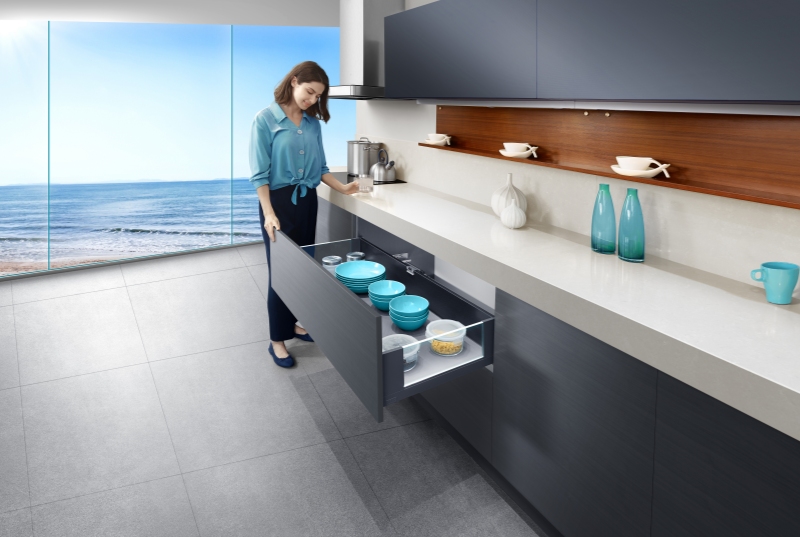
A double-wall system combines metal side structure, slide integration, and front adjustment into a coordinated drawer solution. This matters because the kitchen is not a forgiving environment. Weight, moisture, cleaning routines, and constant daily use all test the drawer repeatedly. A system approach often handles those demands better than a simple drawer box with add-on hardware.
Unlike a basic drawer that treats the sides as separate box components and the slides as a separate specification decision, a double-wall system integrates them into a more structured assembly. The metal side panels contribute stiffness, the running mechanism is designed to match the system, and the adjustment features are built around installation accuracy.
For cabinet makers, this can improve repeatability. For end users, it often improves drawer feel. The drawer opens more predictably, carries load more confidently, and maintains a cleaner appearance internally.
Kitchen storage is highly variable. One drawer may carry cutlery and linen. Another may carry cast-iron pans or stacks of plates. That means load capacity should not be discussed as a generic number detached from the drawer's real use.
Double-wall systems are valuable because they are designed for different storage intensities. In premium kitchens, this helps specifiers assign the correct drawer type to the correct zone rather than forcing one drawer construction everywhere. Heavy lower drawers, wide cookware storage, and deeper pantry pull-outs often benefit most from a system with stronger integrated side structure and clear load grading.
Kitchens expose hardware to humidity, temperature shifts, oil residue, and cleaning contact. For drawer systems, that makes surface protection and long-term finish stability important. While users may not think about corrosion every day, they do notice when metal components lose consistency or when movement quality degrades in demanding environments.
A well-designed metal drawer system should therefore be assessed not only for load but also for how well it stands up to the real kitchen environment. This is one reason system quality matters more than appearance alone.
Double-wall drawer systems often bring several operational advantages. They can support cleaner internal organization, more consistent side geometry, simpler accessory integration, and faster installation logic. Some systems also improve the perception of precision because front alignment and adjustment are built into the hardware platform rather than improvised during fitting.
From the user's point of view, that translates to smooth motion, cleaner storage zoning, and a more deliberate interior feel. From the installer's point of view, it can reduce time spent chasing reveal and front-position issues.
DTC's official product information for the MAGIC-PRO Series describes a luxury drawer system available in soft-close and push-open versions, with 40 kg and 60 kg load options, five side heights, and three color choices. The range also supports gallery rails, glass design variants, and multiple interior-organization accessories. DTC further notes easy assembly and removal, with height, side, and tilt adjustment hidden behind the cover caps.
These details explain why a system like MAGIC-PRO belongs in serious kitchen planning. It is not only about making the drawer look more premium. It is about giving the drawer a structured side system, clear load choices, and integrated alignment features that suit the complexity of custom kitchens.
The strongest cases include high-use kitchens, wide storage drawers, visible premium projects, and installations where organization accessories or clean interior presentation are part of the value proposition. In these scenarios, the drawer system is part of the cabinetry product, not a background part number.
That does not mean every kitchen must use a double-wall metal drawer. But where project expectations are high, the practical benefits often justify the specification.
Kitchen drawers have very different jobs. A shallow drawer for utensils may prioritize organization and smooth daily opening, while a deep cookware drawer needs a capacity and running system that remain stable with uneven contents. Confirm the box width, depth, height and intended load before choosing the side height or operating mode.
| Specification item | Why it affects the result |
|---|---|
| Load option | Helps match the drawer to light, daily or heavy storage. |
| Side height | Affects containment and the visual proportion of the drawer. |
| Operating mode | Determines whether the front is pulled or pressed. |
| Adjustment access | Supports accurate front alignment after installation. |
DTC’s MAGIC-PRO information describes a double-wall metal drawer system with 40 kg and 60 kg load options, Soft-Close and Push-Open versions, five side-panel heights and three color choices. It can be combined with glass panels and internal storage accessories, including gallery rails for added height. Height, side and tilt adjustment are concealed behind the side covers. The drawer is placed onto the runners and closes to lock automatically; pressing the release lever allows removal.
These details have direct functional consequences. The load options support different kitchen storage zones, the side-height choices help contain contents, and concealed adjustment protects the finished appearance while allowing commissioning. A sample drawer should still be assembled and loaded before the full cabinet run is produced. That confirms compatibility between the system, the box construction and the chosen accessories.
Kitchen storage is easier to evaluate when the drawer system is treated as part of the workflow. A cookware drawer needs containment, capacity and stable running. A utensil drawer needs a layout that remains easy to organize. A tall drawer with gallery rails may need a different side height from a shallow drawer below a worktop.
MAGIC-PRO supports this kind of planning through its stated load options, five side heights, three colors, glass-panel and gallery-rail options, concealed adjustment and releaseable runner connection. The selection should still be made from the contents and cabinet drawing. Product flexibility is useful when it solves a documented requirement, not when it is added without a defined purpose.
It uses integrated metal side construction to improve rigidity and create a more coordinated drawer assembly.
Because different kitchen zones carry very different weights, and the drawer system should match those real storage demands.
No. Appearance is part of the appeal, but load support, adjustment, organization, and repeatable installation are equally important.
When the project needs higher-spec storage, multiple load options, integrated organization, and a cleaner premium drawer system.
Metal double-wall drawer systems help custom kitchens perform better by combining structure, running quality, and installation control in one platform. When the drawer is expected to carry more, look cleaner, and align more precisely, a system approach often delivers the most reliable result.
A custom kitchen rarely succeeds through isolated component upgrades. Drawer systems, hinge selection, organizational accessories, and cabinet construction all interact. Double-wall drawer systems are attractive because they package several of those variables into a more coherent storage platform that is easier to repeat across a whole kitchen.
That consistency matters for both installers and end users. When several drawers in the same project share the same structural logic and adjustment language, the kitchen feels more deliberate and is generally easier to fine-tune during installation and service.
A well-chosen double-wall system benefits both the workshop and the homeowner. Installers gain a more integrated adjustment platform, while end users gain a drawer that feels stronger, quieter, and more organized over time. That dual benefit is one reason system drawers continue to grow in relevance in custom kitchens.