2026-08-31
Minimalist cabinetry is often judged by what you cannot see: fewer visual breaks, fewer exposed components, and cleaner lines across the whole elevation. But minimalist design does not stop at the cabinet exterior. Once the drawer opens, the internal hardware needs to feel equally deliberate. That is where slim double-wall metal drawer systems become relevant.
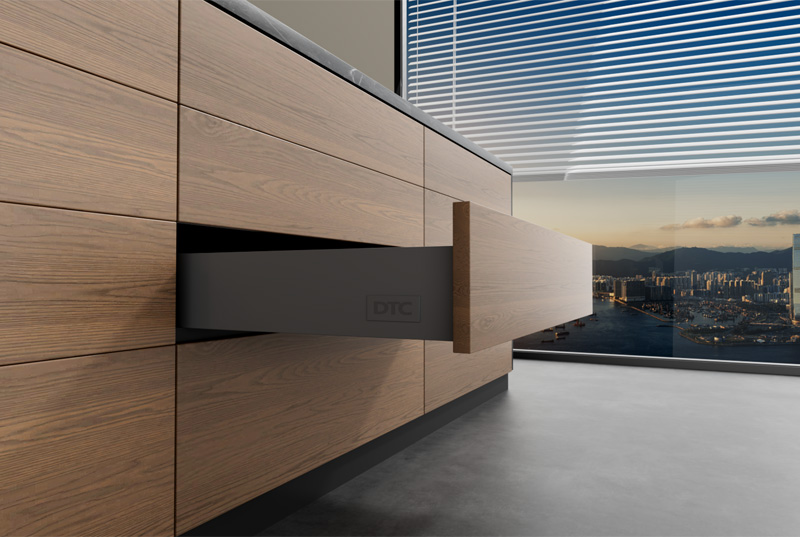
The appeal of a slim-sided drawer is not only visual. In many modern projects, cabinet makers and end users both want more usable storage without increasing the outside size of the cabinet. Straight, narrow metal sides support that goal while also contributing to a more precise, premium interior experience.
Traditional drawer constructions can waste internal volume through thicker side build-ups or angled side geometry that creates awkward corners. In contrast, slim straight-sided systems make better use of the drawer's width and shape. That means square containers, cookware, and organizers can sit closer to the side wall with less dead space.
For minimalist cabinetry, this efficiency matters because the project is usually trying to achieve more with less. Cleaner interiors, better-fit organizers, and a more exacting use of space all reinforce the same design philosophy as the outer cabinet lines.
A luxury feel in cabinetry is not created by decoration alone. It comes from how the product behaves. A drawer that glides smoothly, closes in a controlled way, and reveals a clean, slim internal profile communicates quality immediately.
This is why double-wall metal systems are often associated with higher-end projects. They create a distinct interior character that feels engineered rather than improvised. In handleless or low-ornament kitchens, that experience becomes even more important because the hardware motion carries more of the emotional value.
Minimalist cabinet fronts are unforgiving. Tight reveals and flush visual lines expose even small alignment problems. A drawer system that is easy to assemble and practical to adjust can make a major difference during installation.
The best systems simplify front alignment rather than asking the installer to compensate manually for every minor variation. That matters not only for labor time but also for final consistency across multiple drawers in one kitchen or wardrobe wall.
An upward-opening door does not make every wall cabinet accessible by itself. Shelf height, cabinet depth, countertop clearance and the user's reach still need to be planned together. The lift mechanism should be selected after the door material and approximate weight are known, because opening force and hovering force must suit the finished panel. A cabinet maker should also confirm that the door can travel through its full path without meeting a ceiling, light fitting or adjacent tall unit.
| Planning question | Why it matters |
|---|---|
| Where does the user stand? | Confirms that the open door clears the active work zone. |
| What is the door size and weight? | Determines the adjustment range required for controlled movement. |
| How deep is the cabinet? | Affects visibility and the value of the 107° opening angle. |
| How often is it used? | Helps prioritize stable hovering and controlled closing. |
For a custom project, the installer experience affects the final user experience. A mechanism that can be snap-fitted and adjusted in three directions makes it easier to correct the height, side position and depth after the door is mounted. This matters when a bank of cabinets must share consistent reveals. It also gives the team a practical way to tune the result on site rather than relying only on factory assumptions.
The TOP-STAYS SQ Series should therefore be evaluated as a lift-up support for a defined door condition. DTC describes it for single lift-up doors on wall and high cabinets, with a 107° opening angle, adjustable opening force, hovering force and closing speed. The series is also described for kitchen, living room, office and bathroom applications. These are useful specification facts; they should be checked against the actual panel and cabinet drawing before ordering.
The most useful benefit of a cabinet lift system is clearer access in the space directly in front of the cabinet. It can reduce interference from a side-opening door and make the opening easier to see into, but it does not replace sensible shelf planning or safe reach limits. When the cabinet layout, door weight and adjustment range are considered together, the lift-up format becomes a practical accessibility decision rather than a decorative upgrade.
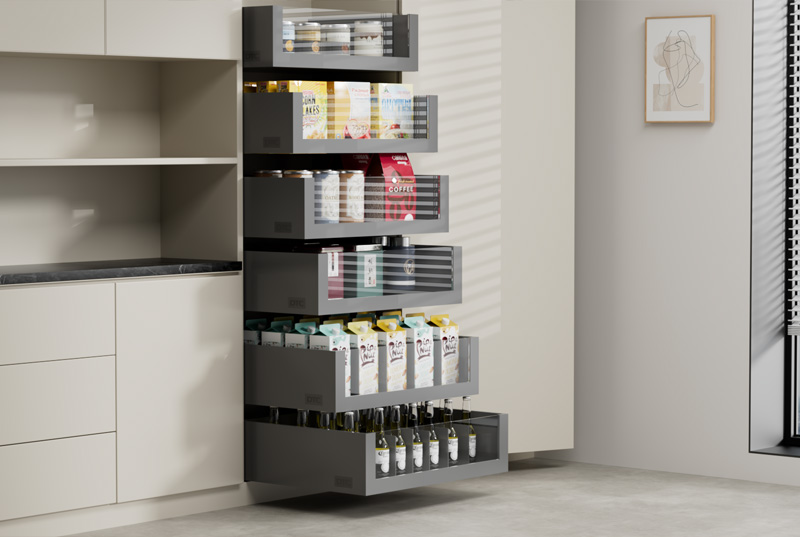
The value of a slim drawer side is realized inside the box. Straight, narrow sides can leave more usable width for square organizers, trays and cookware, but the final result still depends on the cabinet opening, bottom thickness and running clearances. Measure the internal width after the drawer is assembled instead of assuming that a thinner side automatically creates a specific volume increase.
| Design goal | What to verify |
|---|---|
| More usable width | Check organizer and cookware clearance inside the finished box. |
| Minimal visual language | Confirm side covers and adjustments remain clean after fitting. |
| Heavy kitchen use | Select the stated load option and test the drawer loaded. |
| Handleless operation | Confirm Push-to-Open release behavior on the selected runner. |
DTC describes DRAGON-PRO with 13 mm straight double-wall metal sides and full-extension concealed running in 40 kg and 50 kg options. The range supports Soft-Close and Push-to-Open versions, and its height and side adjustment are concealed behind the side cover. The drawer can be installed by placing it on the runners until it locks, with a release lever for removal. These are production and service details as much as appearance details.
The sensible way to specify the system is to connect the 13 mm side profile with the actual cabinet layout and then choose the 40 kg or 50 kg version according to the expected load. A slim profile should not be described as a substitute for capacity planning. Its benefit is a cleaner, more efficient drawer interior when the construction, runner and contents are correctly matched.
The value of a slim drawer side is realized inside the box. Straight, narrow sides can leave more usable width for square organizers, trays and cookware, but the final result still depends on the cabinet opening, bottom thickness and running clearances. Measure the internal width after the drawer is assembled instead of assuming that a thinner side automatically creates a specific volume increase.
| Design goal | What to verify |
|---|---|
| More usable width | Check organizer and cookware clearance inside the finished box. |
| Minimal visual language | Confirm side covers and adjustments remain clean after fitting. |
| Heavy kitchen use | Select the stated load option and test the drawer loaded. |
| Handleless operation | Confirm Push-to-Open release behavior on the selected runner. |
DTC describes DRAGON-PRO with 13 mm straight double-wall metal sides and full-extension concealed running in 40 kg and 50 kg options. The range supports Soft-Close and Push-to-Open versions, and its height and side adjustment are concealed behind the side cover. The drawer can be installed by placing it on the runners until it locks, with a release lever for removal. These are production and service details as much as appearance details.
The sensible way to specify the system is to connect the 13 mm side profile with the actual cabinet layout and then choose the 40 kg or 50 kg version according to the expected load. A slim profile should not be described as a substitute for capacity planning. Its benefit is a cleaner, more efficient drawer interior when the construction, runner and contents are correctly matched.
Yes. Straighter and thinner side geometry can reduce wasted interior space compared with bulkier or angled drawer constructions.
It can be, provided the system is engineered with appropriate load ratings and matching concealed running support.
Because minimalism puts more emphasis on movement quality, precision, and the interior experience once the drawer is opened.
Its concealed adjustment and easy assembly/removal help streamline alignment while keeping the drawer interior visually clean.
Double-wall metal drawer systems support minimalist cabinets by improving both usable space and tactile quality. When a project needs slim geometry, clean internal presentation, and dependable everyday performance, the right system can make the minimalist concept feel complete rather than superficial.
Extra usable width inside a drawer may sound like a small technical detail, but it affects how neatly organizers fit and how easily large kitchen items can be stored. In minimalist cabinets, this kind of efficiency is part of the luxury experience because the drawer feels more resolved and less compromised in use.