2026-06-22
Premium cabinet manufacturers are placing greater emphasis on how furniture performs over long-term daily use. Beyond smooth and quiet operation, clean minimalist interiors have also become an important consideration. In many high-end projects, side-mounted slides often fall short because the hardware remains visible inside the cabinet.
Undermount slides solve the visibility issue by concealing the hardware beneath the drawer. However, different projects have different priorities. Wide, heavily loaded islands require stronger stability and synchronization, quiet residential spaces are more sensitive to closing noise, while high-volume production environments place greater importance on installation efficiency and long-term consistency. Selecting the right undermount system therefore depends on matching it to the specific application and usage requirements.
This article classifies main types of undermount drawer slides and discusses the key factors to consider when matching them to different cabinet applications.

Three technical aspects most clearly distinguish basic undermount slides from systems capable of supporting premium cabinet programs with reliable results.
In wide or heavily loaded drawers, differences in resistance between left and right runners can cause racking. Over repeated cycles this leads to misalignment, uneven wear, and drawers that no longer close squarely. To counter this, many systems use synchronization mechanisms — such as rigid bars, cables, or geared linkages — that force both runners to travel the same distance at the same speed. The practical result is more consistent motion, fewer returns due to binding, and longer service life in demanding applications like large kitchen islands.
Achieving soft-close on the first few cycles is relatively easy. Maintaining the same controlled deceleration after 30,000–50,000 operations is much harder. Dampers must resist dust, humidity, and repeated use without losing effectiveness. Systems that hold their damping characteristics over time provide more reliable performance in kitchens and bathrooms, where users notice slamming or inconsistent closing. Many manufacturers reference 50,000-cycle testing (common in BHMA Grade 1 standards) as a baseline for evaluating long-term damping durability.
In high-volume production, the ability to lock drawers from the front and make adjustments without repeated removal can significantly reduce assembly time. Multi-axis adjustment capabilities help achieve precise alignment efficiently. This becomes especially valuable when producing large quantities or when cabinets must perform reliably after long-distance transportation and on-site installation. The range and precision of adjustment vary between systems; some offer only basic side adjustment while others provide fine control in height, side, and depth. Manufacturers often find that better adjustment capability reduces both initial assembly time and post-delivery service calls.
Undermount drawer slides are typically classified by closing method, extension type, and load capacity. Understanding these categories helps manufacturers and designers match hardware to specific project conditions such as drawer size, usage frequency, content weight, cabinet construction, and acoustic requirements.
Soft-close slides incorporate hydraulic or mechanical dampers that engage in the final centimeters of travel, bringing the drawer to a controlled stop. This type is widely used in kitchens and bathrooms where noise reduction and gentle operation improve user experience. Push-to-open (touch-to-open) slides use a spring mechanism activated by light pressure on the drawer front, allowing handle-free designs common in modern wardrobes and minimalist cabinetry. Standard or hybrid versions provide basic self-closing with optional lighter damping and are often chosen for mid-range projects where full soft-close performance is not required. The selection usually depends on the desired aesthetic, noise expectations, and whether external handles are acceptable in the design.
Full-extension slides allow the drawer to travel completely clear of the cabinet carcass, providing unobstructed access to items at the back. This has become the standard choice for most kitchen base cabinets and wardrobes because it significantly improves usability. Partial extension, often called three-quarter extension, stops the drawer short of full travel; it remains suitable for shallower wall cabinets or lightly loaded applications where maximum reach is unnecessary. Over-extension, available on certain models, permits travel slightly beyond standard full extension and is mainly used in commercial or deep custom storage where the additional reach addresses specific access needs. When specifying full-extension slides, designers must account for the required front clearance, as it affects cabinet placement and overall space planning.
Load capacity is commonly divided into three ranges. Light-duty slides, typically rated below 30 kg, are suitable for smaller drawers used for cutlery, office supplies, or lightweight storage. Medium-duty slides around 40 kg offer good versatility and are widely used for standard kitchen drawers, clothing storage, and bathroom vanities. Heavy-duty slides rated 60 kg and above are designed for larger or deeper drawers carrying substantial weight, such as cookware, tools, or commercial inventory, while maintaining stable synchronized movement. When selecting load capacity, it is important to consider not only the expected content weight but also drawer width and depth, frequency of use, and whether the cabinet side panels provide adequate support at the mounting points. Using a higher-rated slide without matching cabinet construction can shift potential issues from the slide to the cabinet structure.
Most projects combine these classifications based on specific conditions. High-traffic kitchen base cabinets often use full-extension soft-close slides in the 40–60 kg range. Minimalist wardrobes frequently prioritize push-to-open functionality with full extension for clean aesthetics. Commercial casework typically requires higher load ratings and proven durability under frequent use. By evaluating closing behavior, extension requirements, and load capacity against drawer dimensions, usage patterns, and cabinet construction, manufacturers can select slides that deliver appropriate performance, aesthetics, and production practicality for each application.
DTC Hardware developed the MAGIC-MOVE series as a next-generation undermount solution specifically for modern high-end furniture manufacturing. The series integrates synchronized running technology, silent damping technology, and convenient installation technology to meet the needs of kitchens, wardrobes, and commercial furniture applications.
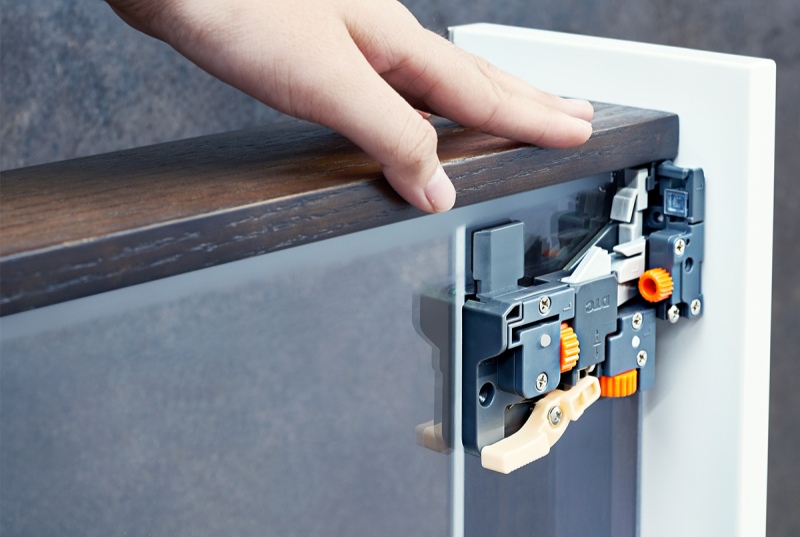
One of the most significant technical advantages of MAGIC-MOVE is its synchronized running system. Traditional slides often experience uneven force distribution between left and right sides during long-term use, leading to inconsistent operation. MAGIC-MOVE uses a synchronization linkage structure that keeps both runners moving in unison at all times. This ensures smooth and stable performance even with large drawers and heavy loads, improving user experience while extending product service life.
To address different market requirements, MAGIC-MOVE offers both soft-close and push-to-open solutions. The soft-close version provides automatic buffering during the final stage of closing, reducing impact and noise. The push-to-open version is suitable for handle-free furniture designs, allowing the drawer to open automatically with a light touch, helping designers create more modern product appearances.
In terms of load capacity, MAGIC-MOVE provides 40 kg and 60 kg options, covering applications from standard kitchen drawers to heavy storage systems. Whether storing tableware, cookware, or large storage items, the slides deliver stable and reliable support.
The product also supports quick installation and multi-dimensional adjustment functions. Installers can complete drawer positioning and calibration rapidly, significantly improving installation efficiency while reducing the need for after-sales adjustments. For furniture manufacturers, this translates to lower installation costs and higher production efficiency. MAGIC-MOVE combines stability, comfort, and installation convenience, making it a strong choice for high-end drawer slide applications.
Kitchens place the highest demands on drawer hardware due to frequent access, varying loads, and exposure to moisture. Full-extension soft-close slides in the 40–60 kg range support daily workflow while maintaining consistent operation under these conditions.
Wardrobes and dressing rooms benefit from quiet, stable motion and clean visual presentation. Push-to-open functionality aligns with contemporary handle-free designs, while concealed mounting keeps visual focus on the cabinetry itself.
Bathroom vanities require corrosion resistance and quiet operation. Commercial and hospitality casework adds requirements for reliable performance under higher cycle counts and heavier use. Across these environments, the consistent priority is dependable function after installation with minimal need for ongoing adjustment or service.
As a globally leading full-house hardware manufacturer, DTC Hardware has been committed to deep technical accumulation and strict quality control since its establishment in 1991, providing solid support for the MAGIC-MOVE undermount slide series.
DTC operates a CNAS-accredited national testing laboratory. For hardware products used in high-frequency, heavy-load, and complex environments, the company has established comprehensive high-standard testing systems. Products undergo tens of thousands of open-close cycle durability tests to simulate long-term high-frequency operation in real household and commercial scenarios, ensuring smooth and stable performance without noticeable degradation after years of use. Rigorous load testing and salt spray corrosion testing are also conducted to guarantee long-term rust resistance in humid environments such as kitchens and bathrooms. These strict testing protocols enable DTC slides to achieve international leading levels in stability, quietness, and durability.
The group’s 750,000 square meter intelligent manufacturing base cluster adopts a vertically integrated supply chain covering precision stamping, automated assembly, and surface treatment, and includes its own environmentally friendly electroplating factory. The manufacturing system has passed TÜV Rheinland factory certification as well as American BHMA and European EN international authoritative standards, ensuring that every batch of products maintains highly consistent excellent quality. With strong technical capabilities, strict quality systems, and a global service network, DTC has become a long-term strategic partner for many top international home furnishing brands, with products exported to more than 130 countries and regions. Choosing DTC means not only obtaining high-performance undermount slide solutions, but also benefiting from professional engineering support and a stable supply chain to achieve efficient production, reliable delivery, and enhanced long-term brand competitiveness in the high-end custom furniture market.
As consumer requirements for furniture quality and user experience continue to rise, undermount drawer slides have evolved from a differentiated feature in high-end furniture to a standard configuration in modern custom cabinetry. Their hidden design, smooth operation, quiet closing, and high load capacity not only enhance product value but also significantly improve the daily experience of end users.
For furniture manufacturers, choosing a technically mature supplier with comprehensive service capabilities is crucial. DTC’s products provide the industry with reliable and efficient solutions. In the future, as the custom furniture market continues to develop, undermount drawer slides will play an important role in more scenarios, driving the furniture hardware industry toward higher quality.