2026-08-31
Drawer slides influence the way furniture feels every single day. Long before someone evaluates material thickness or panel finish, they notice how the drawer opens, how it closes, and whether the motion feels deliberate or awkward. Two of the most common solutions today are push-to-open and soft-close drawer slides. Both can be excellent choices, but they serve different priorities.

In project planning, the mistake is treating them as direct upgrades over one another. They are not opposites where one always wins. They are different operating logics. Choosing correctly depends on handle design, user habits, drawer width, and the desired feel of the final piece.
Push-to-open slides allow the drawer to release and open when the front panel is pressed. This supports handleless designs because the user does not need a pull. In minimalist kitchens, wardrobes, and living room cabinetry, that can be the simplest path to a clean uninterrupted facade.
The key advantage is not only appearance. Push-to-open creates a particular tactile experience. A light press activates the mechanism, which many designers use to reinforce a sleek, modern interaction style. The tradeoff is that the closing logic remains manual. The user pushes the drawer back until it latches.
Soft-close slides prioritize the final stage of closing. As the drawer nears the cabinet, the mechanism slows the motion and pulls the drawer in gently. That creates a quieter, more controlled feel and reduces hard impact over time.
For high-frequency applications such as kitchen storage, cutlery drawers, pantry drawers, and bedroom case goods, soft-close is often preferred because it supports a calm, consistent closing experience. The benefit is especially noticeable in shared households where drawers are opened and shut repeatedly throughout the day.
If the project uses visible pulls or edge pulls, soft-close often becomes the more natural default because the opening action already has a dedicated grip point. If the project is truly handleless, push-to-open deserves strong consideration because it solves the interaction problem directly.
Drawer width is another major factor. Wide handleless drawers require dependable synchronization so the user can press in different front positions without causing skewed release behavior. Without synchronization, push-to-open can feel inconsistent on wider boxes.
Usage pattern matters too. Some clients care most about a seamless facade. Others care most about gentle, quiet closing. The right slide is the one that supports the intended daily habit, not just the showroom narrative.
As drawer width increases, motion consistency becomes more important. A narrow drawer may work acceptably with a simple mechanism, while a wide drawer exposes any imbalance quickly. This is particularly relevant for handleless kitchens where users may press the drawer front from an off-center position.
That is why synchronized push-to-open systems are valuable. They help both sides respond together, so the drawer can release more reliably from multiple touch points. In soft-close versions, synchronization also contributes to a smoother, more stable running feel on broader storage drawers.
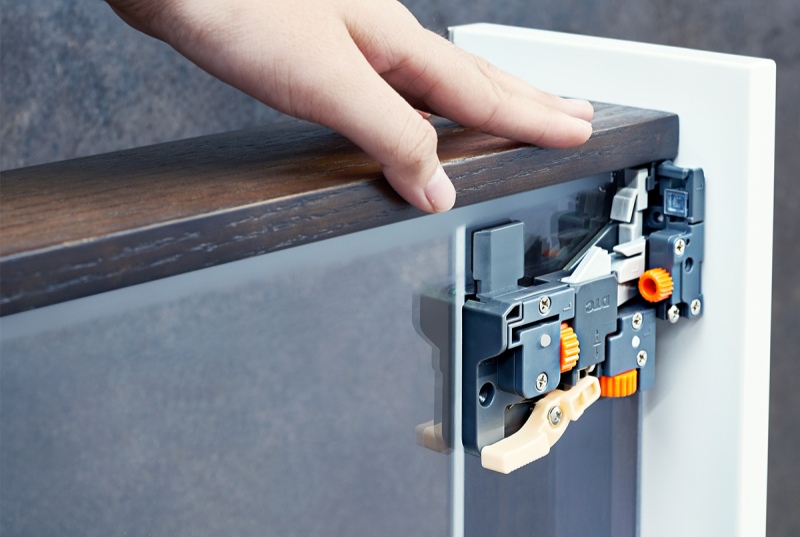
According to DTC's official product page, the MAGIC-MOVE Series is a concealed undermount slide platform available in both soft-close and push-open versions. The system uses synchronized full-extension running, nylon rollers for quiet sliding, and concealed mounting. DTC also states that the push-open version uses a synchronizing rod that allows even wide drawers to open when pressed in any position. Load options include 40 kg and 60 kg, and the system supports tool-free height, side, and depth adjustment through robust front locking devices.
Those details make the series useful in exactly the comparison this article addresses. It supports both operating logics, but it does not treat them as interchangeable. Instead, it gives specifiers a way to choose opening behavior according to cabinet design while keeping high-performance concealed running as the base.
Choose push-to-open when the project needs a true handleless look, especially in contemporary cabinetry where the clean front elevation is part of the concept. Choose soft-close when quiet and controlled closing is the higher priority, especially for frequently used drawers with conventional pulls or integrated grips.
If the project includes multiple zones, it may even be sensible to mix solutions. A display cabinet or premium handleless vanity might use push-to-open, while main kitchen utility drawers use soft-close for comfort and noise reduction. Good hardware planning does not have to force one answer everywhere.
Push-to-open is a logical option when the design intentionally removes handles and the user needs a light press on the front to start opening. It works particularly well on drawers that are opened with a free hand or a knee during kitchen tasks. On a wide drawer, the two sides must respond together. DTC describes the MAGIC-MOVE Push-Open version with a synchronization rod connecting the left and right slides, so a touch away from the center can still operate the drawer more evenly.
Soft-close is more suitable when the project has handles, when quiet closing is the primary goal, or when users are expected to close the drawer with a deliberate push. It reduces the speed of the final closing stage, which is valuable for frequently used kitchen and wardrobe drawers. It does not provide the handleless opening action of push-to-open, so the opening method and front hardware should be decided together.
| Project condition | More suitable starting point | Reason |
|---|---|---|
| Handleless kitchen | Push-to-open | Pressing the front replaces a pull. |
| Wide handleless drawer | Push-to-open with synchronization | Helps both sides respond to an off-center press. |
| Handle-equipped drawer | Soft-close | The handle provides opening control; quiet closing is the priority. |
| High-frequency family kitchen | Either, after trial fitting | Choose between opening preference and closing feel. |
MAGIC-MOVE is described with both Soft-Close and Push-Open versions, synchronized full extension, nylon rollers, 40 kg or 60 kg load options, hidden undermount installation, front locking and tool-free height, side and depth adjustment. The correct version depends on the specified use case. It is not necessary to present one operating mode as universally better.
A showroom demonstration can hide important differences. Test push-to-open with the final front fitted and test soft-close with the drawer loaded. Check the pressure needed to trigger the release, the distance the drawer travels after the press, and the final closing movement. On a handleless design, also confirm that adjacent fronts do not trigger one another during normal use.
MAGIC-MOVE’s synchronization rod is especially relevant to wide push-open drawers because the user may press near one side. The project should still follow the manufacturer’s preparation and adjustment requirements. A short prototype test gives the cabinet maker evidence for choosing the mode before the entire kitchen is produced.
No. It is strongly connected to handleless design, but it also changes the way users interact with the drawer on every opening cycle.
Not exclusively, but it is most commonly chosen where a dedicated pull method already exists and gentle closing is the main goal.
Because wide fronts are often pressed off center. A synchronized mechanism helps the drawer release consistently from different positions.
Yes. Some systems, such as DTC's MAGIC-MOVE platform, are designed in both soft-close and push-open versions.
Push-to-open and soft-close slides solve different priorities. One focuses on opening logic and handleless design. The other focuses on controlled, quiet closing. Once the project team evaluates facade style, drawer width, user habits, and performance expectations together, the right option usually becomes clear.
One useful way to compare push-to-open and soft-close slides is to think about the interaction the project is trying to create. Push-to-open supports a visual concept first and then adapts the opening action to match it. Soft-close often starts from comfort and controlled motion, then supports the rest of the cabinet specification around that behavior.
Neither direction is automatically better. What matters is whether the drawer front, expected touch pattern, and user habit all point toward the same solution. In premium custom work, that level of alignment is often what separates an intentional design choice from a hardware compromise.
In larger custom interiors, it is common for different drawers to use different opening logics. Handleless feature areas may use push-to-open, while high-use utility drawers rely on soft-close for comfort and noise control. That kind of mixed planning is not inconsistency; it is a sign that the hardware was chosen according to actual use.